
The next industrial economy will be built from carbon, one atom thick.
Graphene Valley Corporation builds and operates the industries that sit on top of graphene: materials, energy, compute, data, health, water, construction, mobility, and the finance that lets them scale together.
Introducing GVC
GVC is building the global infrastructure and technology backbone for large-scale, commercially viable production of graphene. At the core of the platform is GVC's patent-protected, one-step process for producing graphene directly from biomass, designed to change the economics, scalability, and sustainability of graphene production.
Beyond production, GVC is developing a portfolio of industry-defining products and applications built on the performance characteristics of its graphene. These products are positioned for commercialization and have the potential to create entirely new markets while delivering order-of-magnitude advantages over incumbent technologies.
The platform is vertically integrated, from proprietary graphene production through high-value applications. That integration creates significant barriers to entry and allows GVC to scale across industries and geographies.
Breakthrough performance
GVC's products and applications are engineered to deliver breakthrough performance across the dimensions that decide whether a material or a machine is worth using:
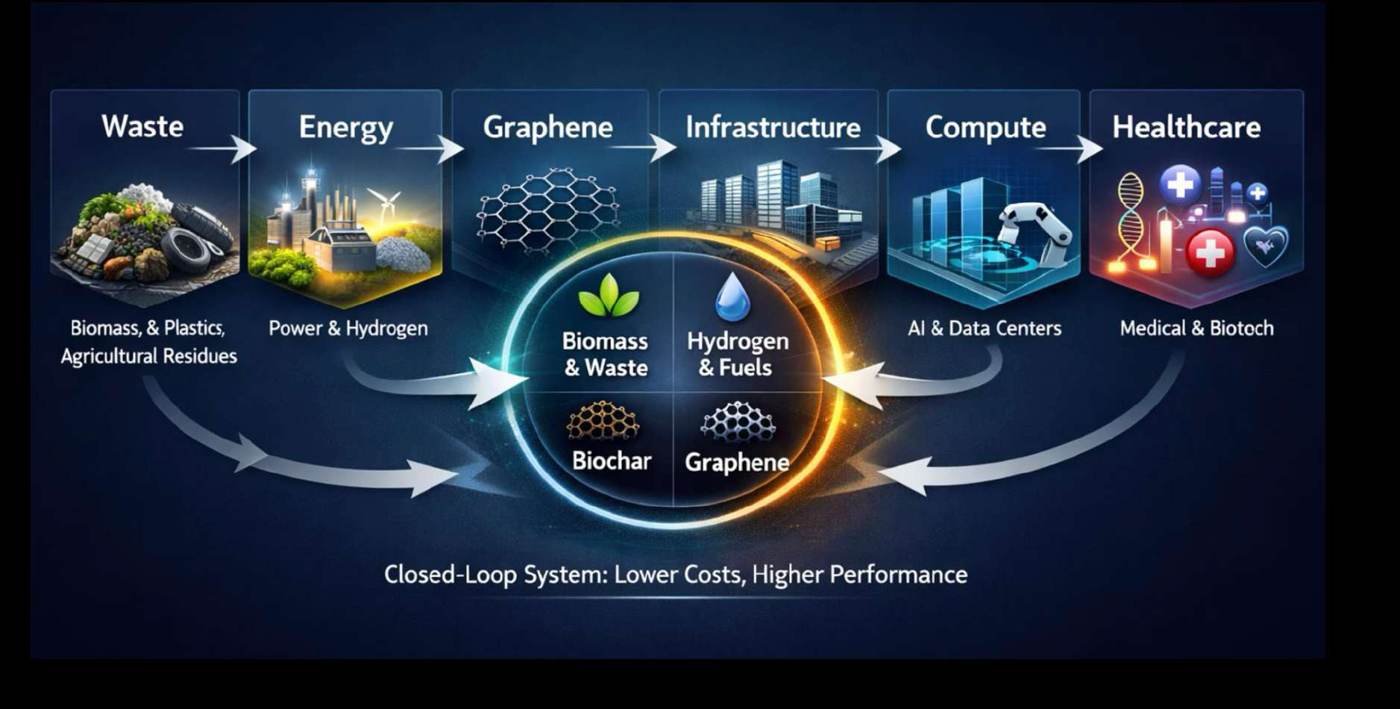
Together these advantages address fundamental limitations of existing materials and technologies. The result is products that are lighter, stronger, safer, faster, more efficient, and more durable, and pathways to applications and markets that were previously impractical on technical or economic grounds.
Better industries, a cleaner planet, a stronger humanity
The PillarStack is a business model. It is also a way to do three things at once that the world has been told it must trade off against one another.
Improve every industry
Graphene makes materials stronger and lighter, electronics cooler and faster, concrete longer-lived, batteries denser, water cleaner, and soil more productive. GVC applies that advantage across twelve industries and connects them so each one improves the others.
Save the planet
GVC's core process makes graphene from biomass and waste, so carbon that would have entered the atmosphere is locked into materials that last for decades and into soil products that hold it for longer. Waste becomes feedstock instead of pollution. Buildings and infrastructure use less material and last longer. The company is built to be carbon-negative in its operations and to make its customers cleaner in theirs.
Save energy
A kilowatt saved is a kilowatt produced. Graphene thermal materials cut the energy spent cooling compute. Efficiency systems cut what motors, pumps, and buildings consume. Distributed generation and storage keep power where it is used. Across the stack, GVC treats energy efficiency as a product line, not a slogan.
Uplifting humanity
All of that would matter less if it stopped at balance sheets. It does not. The technologies that make GVC's industries better are the same ones that give a community the six things it needs to stand on its own.
Soil restored with a product made to a specification. Local food production. Agricultural waste turned into value instead of smoke.
Graphene filtration and desalination, wastewater reuse, and sanitation at the point of use, from a household to a hospital.
Local, resilient, carbon-negative power from waste, biomass, and storage, so no region waits for a grid that may never come.
Stronger, faster, longer-lived construction from graphene materials, deployable as modular systems where they are needed.
Diagnostics and treatment brought to the patient: ten-minute cardiovascular screening, imaging, metabolic and regenerative therapy, and a record that learns.
Trusted data infrastructure with provenance, consent, and sovereign hosting, so a person's or a nation's information stays its own.
Delivered together, in one place, run by the people who live there, these six are what we call GVC LIFE. Delivered across the economy, they are what Empowering Life means.
Every important system is hitting a physical limit
Compute is limited by heat and power. Cities are limited by materials and water. Health systems are limited by late detection. Food is limited by soil. Energy is limited by storage and distribution. None of these are software problems. They are physics problems, and physics problems get solved with better materials, better machines, and better information about how those machines perform.
Graphene changes what is possible in every one of those eight areas. GVC exists to turn that possibility into products people buy, infrastructure people use, and data that makes the next product better than the last.
Browse GVC by pillar
GVC is organized as a lattice, the same way graphene is. Each pillar is an industry we operate in. Each one supplies the others. Click any hexagon.
Pick your door
Why GVC exists
Most companies pick one market and try to win it. GVC does something different. It builds the shared infrastructure of the next industrial economy, with graphene as the material advantage running through all of it.
The problem with one-market companies
A materials company sells a kilogram of graphene once and the customer keeps the value. A device company builds a good product and then hopes someone else installs it, uses it correctly, and captures the data. An energy company sells power and never sees the carbon it could have turned into a material. A data center rents space and watches its customers keep the intelligence.
Each of these businesses is fine on its own. Each of them leaves most of the value on the table because it stops at its own boundary.
What GVC does instead
GVC operates the whole chain. Graphene is produced directly from biomass in a patent-protected, one-step process, functionalized, and turned into materials. Materials go into products. Products go into infrastructure GVC owns or operates: data centers, clinics, water systems, energy plants, buildings, fleets. That infrastructure generates performance data. The data feeds AI that makes the next material, product, and deployment better. Finance sits across all of it so that a good technology never stalls for lack of capital structure.
We call the structure the PillarStack. Each pillar is a real industry. Each pillar is a customer of the others and a supplier to the others. That is the closed loop, and it is the reason the economics of GVC look different from the economics of any single company inside it.
Empowering Life
The phrase on our logo is the test we apply to every pillar. Does this make people healthier, better fed, better housed, better powered, safer, and more capable of doing their work? Better compute means doctors read scans faster. Better soil means a region feeds itself. Better materials mean a bridge lasts sixty years instead of thirty. Better data means a patient is treated before a disease becomes an emergency.
AI runs through all of this, and we use it deliberately: to make scientists, engineers, physicians, farmers, and builders better at what they do. People remain responsible for the decisions. AI makes them faster, better informed, and less likely to miss something.
Six securities
The world is organizing itself around a small number of questions. Can a country feed itself. Can it secure clean water. Can it power itself. Can it house its people. Can it keep them healthy. Can it protect its data and its infrastructure. GVC is built to answer all six with the same set of technologies, and to prove the answer by deploying them in real places rather than describing them in decks. That deployment is GVC LIFE.
Without polluting the planet
Most industrial growth has been paid for in carbon and waste. GVC's growth runs the other direction. The graphene at the base of the stack is made from biomass and waste, which takes carbon out of circulation and locks it into materials that last for decades. Soil products hold carbon in the ground. Waste-to-energy replaces landfill and open burning. Longer-lived concrete and infrastructure mean less cement poured and less material mined. Rare earth recycling means less extraction. The company is designed so that scaling it up removes carbon from the atmosphere rather than adding it, and so that every customer who adopts its materials pollutes less than before.
And using less energy to do it
Heat is where the modern economy wastes the most. Graphene thermal materials move heat out of electronics with less cooling energy. Efficiency systems recover what motors, pumps, compressors, and buildings throw away. Distributed generation and storage cut the losses of moving power long distances. GVC treats energy saved as energy produced, and sells it that way.
The PillarStack model
GVC is a company of pillars. Each pillar is an industry. Each one owns technologies, products, physical assets, and the data those assets generate. The pillars are built to reinforce one another.
Four levels
- GVC parent. Vision, capital, governance, brand, and the rules that keep the pillars working as one system.
- Executive operating layer. Finance, legal, regulatory, manufacturing, construction, sales, compute, data, AI, strategy, government relations, and capital markets. These functions serve every pillar so no operating company has to rebuild them.
- Pillar holding companies. Domain-specific stacks. Each holds the companies, intellectual property, physical assets, and data assets for its industry.
- Operating companies and technologies. Products, patents, manufacturing, customer contracts, and revenue. This is where the work gets done and the money is made.
The pillars
How the pillars feed each other
This is the part that matters most, and the part a single-market company cannot copy.
- Graphene supplies Advanced Materials. Advanced Materials supplies every other pillar with thermal materials, films, coatings, composites, battery materials, filtration, and sensors.
- Energy powers Compute, Construction, Agriculture, Health, and Mobility. Energy also produces carbon outputs that feed Graphene and Agriculture.
- Agriculture and Water supply biomass to Energy and carbon pathways to Graphene, and clean water to Health and Construction.
- Compute serves Health, Data, Defense, Materials modeling, and Finance. Compute depends on Energy, Advanced Materials, and Construction to exist at all.
- Data and AI sit under every pillar and turn operating results into better products.
- Finance structures the capital for each kind of asset and makes pay-per-use and project models possible in Health, Energy, and Construction.
- Defense and Security is a customer of nearly everything above and a reason to build all of it to a higher standard.
Three sources of demand
External customers are the first. Governments and sovereign programs are the second. GVC itself is the third, and it is the one most companies never have. When GVC builds a data center, it uses its own thermal materials, its own concrete additives, its own power, and its own trusted data layer. The data center is a customer, a proving ground, and a reference site at the same time. That internal demand lowers the risk of every external sale that follows.
Principles
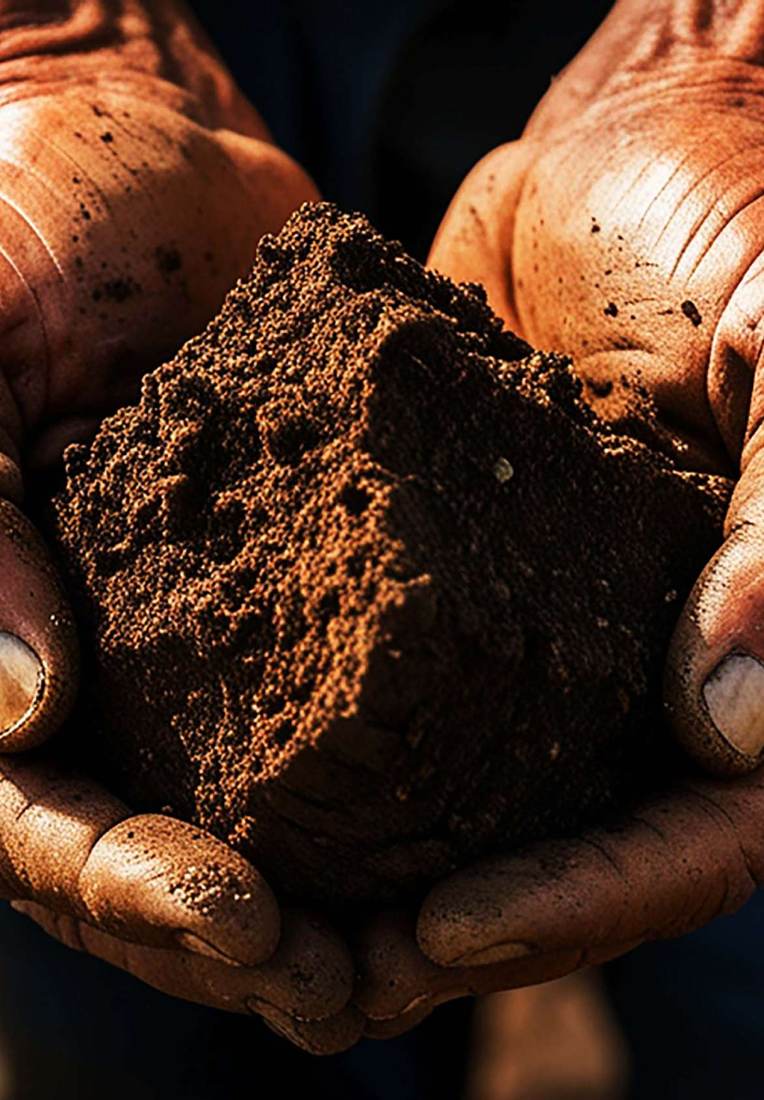
- Waste is feedstock. Agricultural residue, biomass, and municipal waste become energy, hydrogen, carbon materials, and soil products.
- Efficiency is production. A kilowatt saved in a motor or a cooling system is as valuable as a kilowatt generated.
- Infrastructure should not be dumb. Materials and assets report on their own performance.
- Deployment is controlled. GVC does not hand a technology to someone else and hope. It owns the channel to the patient, the farmer, the facility.
- Data is an asset with governance. It is captured, protected, and used under rules, and it is what makes the next version better.
- AI augments people. It does not replace the physician, the engineer, or the builder. It makes them better.
How graphene becomes value
The graphene market itself is small. The industries graphene improves are measured in trillions. GVC is built to capture the second number, not the first.
The value ladder
A concrete example
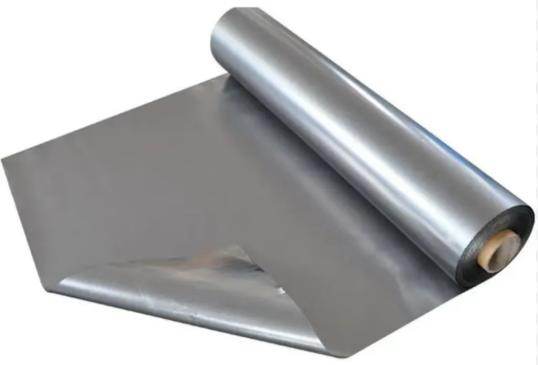
A kilogram of graphene sold to a compounder earns a one-time margin and disappears into someone else's product. The same graphene, functionalized for thermal use and formed into a qualified heat-spreading film, goes into a data-center cooling contract that pays every month. The film reports temperatures. The temperatures show which server racks run hot. The data tells our engineers how to make a better film and tells our sales team exactly what the next customer's savings will be. The first path is a sale. The second path is a business.
Why the graphene layer is still essential
None of the higher rungs exist without control of the bottom one. Owning production, through a one-step process that starts with biomass rather than mined graphite, means owning cost, consistency, and supply. Owning functionalization means owning the specification the customer qualifies against. Owning the patent portfolio means the ladder cannot be climbed by a competitor using our chemistry. GVC keeps the bottom rung so it can own the top ones.
Where the compounding happens
Each rung on the ladder multiplies the value of the rung below it. Each pillar that adopts a material is a new set of rungs. And because GVC deploys into its own infrastructure first, the data starts flowing before the first outside customer signs.
What graphene is
A single layer of carbon atoms, arranged in hexagons, one atom thick. It is the strongest material ever measured, one of the best conductors of heat and electricity known, nearly transparent, and flexible. Read it at the depth you want.
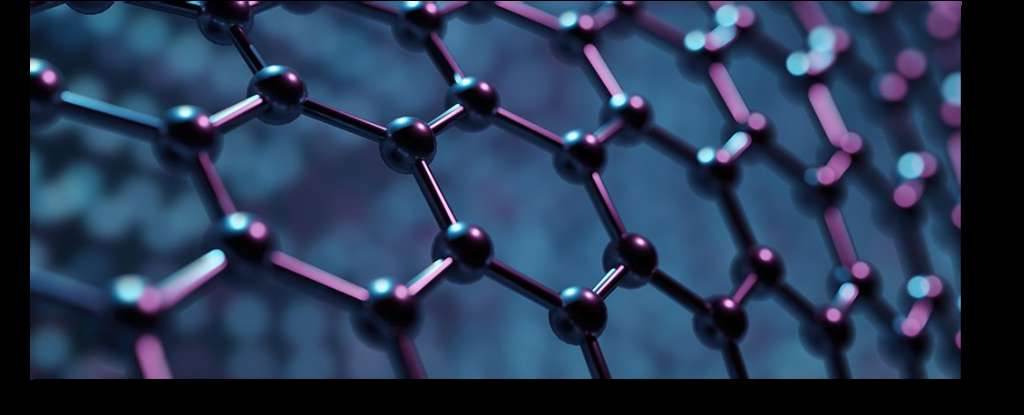
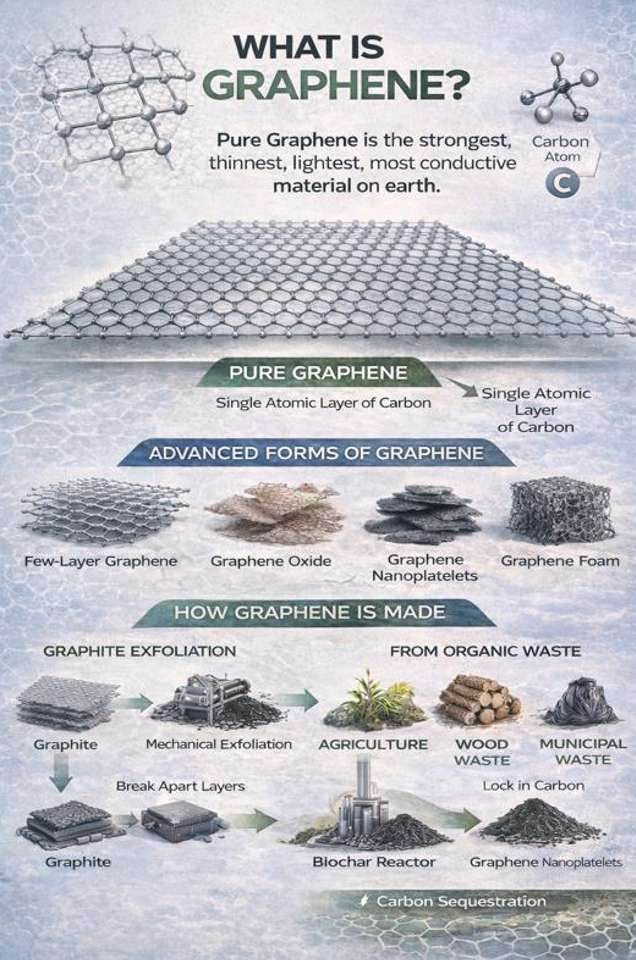
Take a pencil. The gray in it is graphite, which is millions of carbon sheets stacked like paper. Peel off one sheet and you have graphene.
That one sheet is about two hundred times stronger than steel by weight, moves heat faster than copper, carries electricity with almost no resistance, and lets nearly all light through. It is also flexible and has enormous surface area for its mass.
The catch: a perfect sheet of graphene does not want to mix with anything. It is slippery, chemically inert, and hard to use straight from the reactor. Making it usable is where the real work, and the real business, is.
Structure
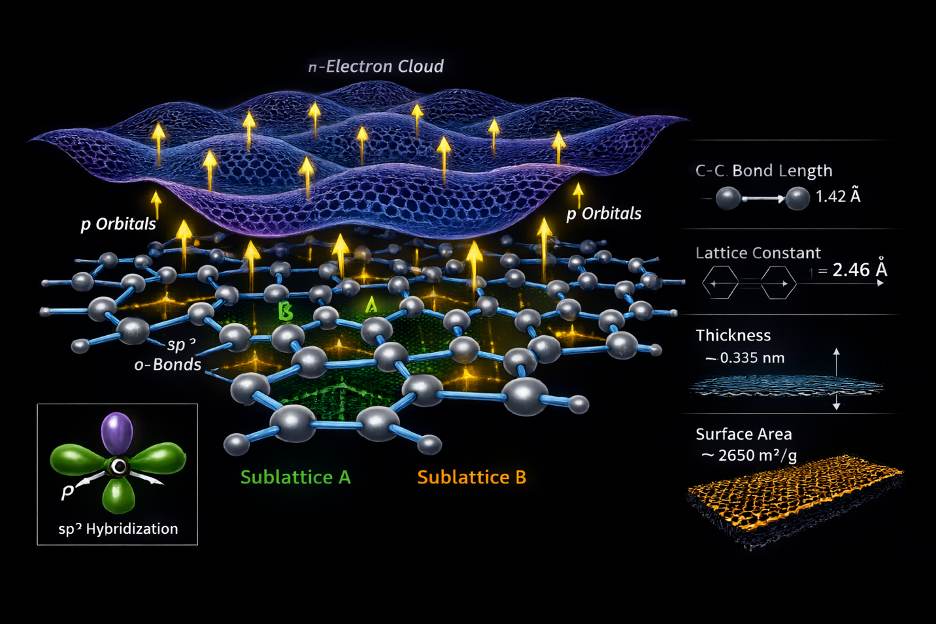
Graphene is carbon in its purest two-dimensional form. Each carbon atom bonds to three neighbors in a flat honeycomb, and the fourth electron of every atom is shared across the whole sheet in a cloud above and below the plane. That shared cloud is why graphene conducts so well: electrons move across it almost as if they had no mass.
Properties in plain terms
- Strength: the highest tensile strength measured in any material, with stiffness comparable to diamond. A sheet the thickness of plastic wrap would support the weight of a car.
- Heat: thermal conductivity several times higher than copper in the plane of the sheet. Heat spreads sideways through graphene extremely fast, which is why it matters for cooling electronics.
- Electricity: electron mobility far above silicon. Current flows with very little resistance and very little heat generated.
- Light: a single layer absorbs about 2.3 percent of visible light. It is nearly invisible, yet electrically active.
- Surface: about 2,630 square meters of surface per gram. A gram of graphene, unfolded, would cover half a football field. That is why it matters for batteries, filters, and catalysts.
- Barrier: perfect graphene blocks even helium atoms. That makes it a candidate for coatings, corrosion protection, and membranes.
Why it has been slow to reach products
Three reasons. First, producing consistent graphene at industrial scale and industrial cost took twenty years to work out, and much of what is sold as graphene is graphite dust. Second, pristine graphene is chemically inert and repels water, so it will not disperse in polymers, resins, cements, or liquids without help. Third, it has no natural electronic bandgap, so it cannot be switched off like silicon, which limits its direct use as a transistor.
All three problems have engineering answers. Consistent production is a process-control problem. Dispersion and compatibility are solved by functionalization, which means attaching chemical groups to the sheet so it bonds with the material it is going into. The bandgap problem is solved by functionalization too, or by using graphene where a bandgap is not needed: heat, conduction, strength, barrier, and sensing.
Graphene quantum dots
Cut graphene into flakes a few billionths of a meter across and it starts to glow. At that size electrons are confined, and the confinement creates discrete energy states. Change the size, the edges, or the chemistry on the surface and you change the color of the light and what the dot responds to. That makes graphene quantum dots useful for biological imaging, chemical sensing, photonics, and energy devices, and it is one of the places where graphene's chemistry becomes programmable.
Lattice parameters
| Parameter | Value |
|---|---|
| Carbon to carbon bond length | 1.42 Å |
| Lattice constant | 2.46 Å |
| Monolayer thickness | about 0.335 nm |
| Specific surface area, theoretical | about 2,630 m²/g |
| Hybridization | sp², three sigma bonds per atom, one delocalized pz electron |
| Sublattices | Two interpenetrating triangular sublattices, A and B |
Electronic structure
Near the K and K′ points of the Brillouin zone the conduction and valence bands touch at the Dirac point, and the dispersion is linear rather than parabolic. Charge carriers behave as massless Dirac fermions with a Fermi velocity on the order of 10⁶ m/s, which produces very high mobility and ballistic transport over micron distances in clean samples. The absence of a bandgap is intrinsic to the pristine lattice. Bandgaps can be opened by chemical functionalization (fluorographene reaches roughly 3 eV), by confinement in nanoribbons and quantum dots, by substrate interaction, or by applying a field to bilayer graphene.
Mechanical and thermal figures
Measured intrinsic tensile strength of defect-free monolayer is about 130 GPa with a Young's modulus near 1 TPa. In-plane thermal conductivity of suspended monolayer has been measured in the range of several thousand W/m·K, well above copper at roughly 400. Real industrial graphene, which is multilayer, defect-bearing, and dispersed in a matrix, delivers a fraction of these intrinsic values. The engineering question is always how much of the intrinsic property survives the route into a product. That question is answered by process control and by functionalization chemistry, and it is the core of GVC's materials work.
Surface chemistry
The basal plane is aromatic and carries no dangling bonds, so adsorption on pristine graphene is by weak van der Waals interaction and the material is hydrophobic and inert. Edges, vacancies, grain boundaries, and Stone-Wales defects carry localized electronic states and are far more reactive. Most industrial functionalization exploits those sites, or begins from graphene oxide, which arrives already decorated with hydroxyl, epoxy, and carboxyl groups.
Historical note
Free-standing graphene was isolated and characterized in 2004, work recognized with the 2010 Nobel Prize in Physics. Theoretical description of the lattice goes back to the 1940s, and graphene-like layers had been observed and discussed for decades before isolation.
Making graphene usable
The business is not the sheet. The business is the chemistry that lets the sheet bond with polymers, metals, cement, water, and living tissue, and the process control that makes every batch the same.
Pristine graphene is like a perfectly waxed floor: nothing sticks. Functionalization attaches chemical handles to the sheet so it can grab onto whatever material it is going into. Different handles for different jobs: one set for concrete, another for plastics, another for water filters, another for biological sensors.
GVC makes graphene from organic feedstock, functionalizes it for each application, and delivers it as a ready-to-use material with a specification the customer can test against. That is what turns a laboratory curiosity into a product.
Two families of chemistry
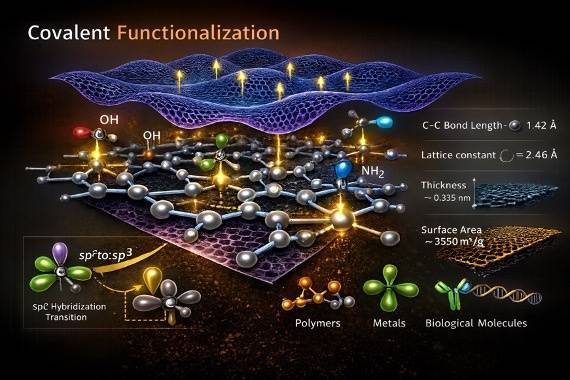
Covalent functionalization forms real chemical bonds to the carbon lattice. It changes some carbon atoms from flat sp² bonding to tetrahedral sp³ bonding, which interrupts the electron cloud locally. Done heavily, it costs conductivity. Done in moderation, it produces graphene that disperses in polymers, bonds to metals, and can carry biological molecules, while keeping most of the strength and much of the thermal performance.
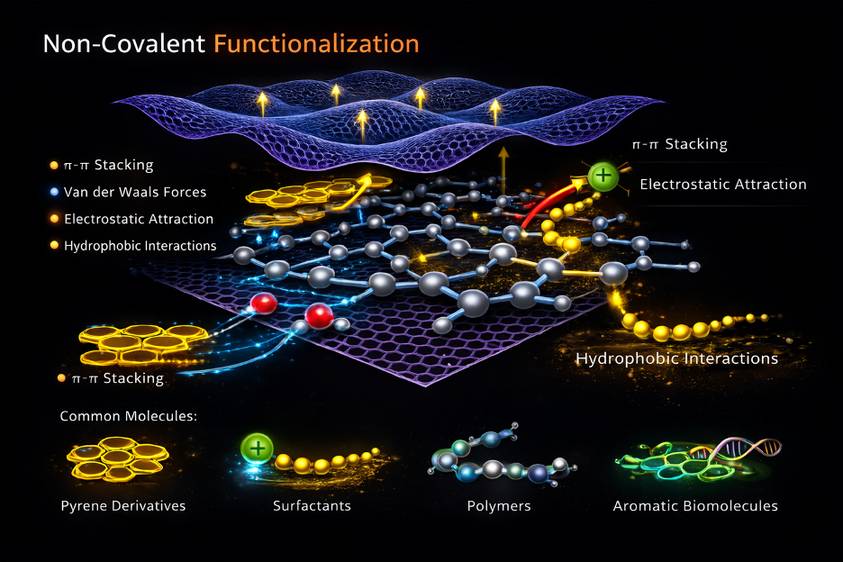
Non-covalent functionalization attaches molecules by physical stacking and electrostatic attraction rather than bonds. The lattice stays intact, so conductivity is preserved. It is the route of choice when electrical or thermal performance is the reason for using graphene in the first place.
The industrial starting point
Most large-scale functionalized graphene begins as graphene oxide, made by oxidizing graphite so the sheets separate and arrive covered in oxygen groups. Those groups are the handles. Reduce the oxide partially and you get a material that keeps some handles and recovers much of its conductivity. The art is in choosing how far to go for each application.
What GVC controls
- Feedstock and process. Graphene produced directly from biomass in GVC's patent-protected, one-step process, which changes the cost and sustainability of production and ties the Graphene pillar to Agriculture and Energy where the feedstock originates.
- Production. Scalable process with the consistency that qualification demands. A customer qualifies a specification, not a chemistry lecture.
- Functionalization. Application-specific surface chemistry: thermal, structural, electrochemical, filtration, biological, catalytic.
- Application-ready forms. Powders, dispersions, masterbatches, films, coatings, and formulated admixtures that drop into a customer's existing process.
- Standards and tolerances. Every product ships against a specification, and every batch is measured against it.
- Intellectual property. A patent portfolio covering production and functionalization chemistry, which is both a defense and an income line.
Covalent routes
- Diazonium chemistry: aryl diazonium salts undergo electron transfer with the lattice, release nitrogen, and the resulting aryl radical bonds to a carbon atom. Density is controllable; widely used for sensor surfaces.
- Cycloadditions: [2+1] cyclopropanation and [3+2] azomethine ylide additions create ring structures on the lattice with limited disruption of the π system.
- Fluorination: converts sp² to sp³ across the sheet, yielding fluorographene, an insulator with a wide gap (about 3 eV), strongly hydrophobic and chemically stable.
- Heteroatom doping: nitrogen and boron substitution into the lattice for catalysis, fuel cells, and electronics.
Non-covalent routes
π-π stacking with pyrene derivatives and aromatic biomolecules, surfactant and polymer wrapping, and electrostatic assembly. These preserve mobility and conductivity and are the preferred routes for thermal and electrical products.
Defect-mediated chemistry
Vacancies, grain boundaries, and Stone-Wales defects carry localized states and higher reactivity. Selective functionalization at those sites modifies properties while leaving the majority of the lattice intact. Defect engineering is also how graphene quantum dots acquire their tunable emission.
Modeling
Density functional theory is the working tool for predicting adsorption energies, reaction pathways, band structure, and catalytic activity of a proposed functionalization before it is run. GVC's Innovations Lab uses simulation to narrow the chemistry space before committing to synthesis, and keeps negative results as part of the record.
Manufacturing routes in use
Modified Hummers oxidation to graphene oxide followed by controlled reduction; chemical and electrochemical exfoliation; plasma functionalization; laser patterning; and continuous chemical vapor deposition for film. The central manufacturing challenge is uniform functional-group distribution at scale without loss of lattice integrity.
Maturity of the main routes
| Route | Typical use | Maturity |
|---|---|---|
| Graphene oxide chemistry | Composites, coatings | Industrial |
| Reduced graphene oxide | Batteries, supercapacitors | Industrial |
| Polymer grafting | Structural composites | Commercial |
| Diazonium functionalization | Sensors | Commercial |
| Metal nanoparticle anchoring | Catalysis | Commercial |
| Nitrogen doping | Catalysis, fuel cells | Early commercial |
| Fluorination, boron doping, plasma | Electronics, coatings | Emerging |
| Biomolecule functionalization | Biosensors | Emerging |
| Edge and defect engineering, CVD heterostructures | Nanoelectronics, quantum materials | Academic |
What is proven, what is not
Graphene has been oversold for twenty years, mostly by people selling graphite dust. GVC's credibility depends on saying plainly which applications are proven, which are being qualified, and which are still promising.
Proven and in commercial use
- Thermal management films, foams, and heat spreaders for electronics.
- Additives for concrete, asphalt, and cement that improve strength, durability, and water resistance.
- Conductive inks, coatings, and anti-corrosion coatings.
- Reinforcement of polymers and composites for weight reduction and fatigue life.
- Electrode additives for batteries and supercapacitors.
- Catalyst supports for chemical and electrochemical processes.
Qualified or in qualification for specific customers
- Filtration and desalination membranes.
- Graphene-enhanced circuit boards and interconnects for electronics.
- Soil amendments produced to a tight specification for agriculture.
- Sensors built on functionalized graphene surfaces.
- Rare earth separation and recovery media.
Promising, still in development
- Graphene-based logic and processors. The bandgap problem is real. The likely near-term wins are interconnects, thermal paths, and sensor front ends, not a graphene CPU.
- Biomedical implants and drug delivery. The chemistry is promising; the regulatory path is long.
- Graphene quantum dot photonics and quantum devices.
- Self-sensing structural materials at building scale.
How to read a graphene claim
Ask what form the material is in, how many layers, what the defect density is, how it was dispersed, and what property was measured in the finished product rather than in the raw material. Intrinsic properties measured on a perfect suspended monolayer are physics. Properties measured in a cured composite are engineering. GVC sells engineering.
The pillars
Twelve industries, one lattice. Each page answers the same four questions: what the pillar does, what graphene does for it, what it gives back to the rest of GVC, and what products it makes.
Product descriptions on these pages describe capability and function. Product and company names are introduced as each line reaches market under GVC branding.
Graphene
The material advantage that runs through everything else.
What it does
Produces graphene directly from biomass through a patent-protected, one-step process, functionalizes it for specific applications, delivers application-ready forms to a specification, and holds the patent portfolio that protects the chemistry.
What it gives back
Products and capabilities
- Pristine graphene at industrial scale In productionSingle- and few-layer graphene produced directly from biomass in a one-step, patent-protected process, with the batch consistency needed for customer qualification and the economics needed for industrial scale.
- Functionalized graphene gradesSurface chemistry tuned for thermal, structural, electrochemical, filtration, biological, and catalytic use. Each grade ships against a written specification.
- Application-ready formsDispersions, masterbatches, powders, films, and formulated admixtures designed to drop into a customer's existing process without retooling.
- Graphene quantum dotsNanoscale graphene with tunable emission for sensing, imaging, photonics, and energy devices.
- Patent licensingA production and functionalization patent portfolio that has not yet been licensed and that GVC intends to enforce and license as a revenue line.
Advanced Materials
Where graphene becomes something a customer can buy.
What it does
A data center does not buy graphene. It buys cooling, uptime, density, and lower power cost. A builder does not buy graphene. It buys stronger concrete and a longer-lived structure. This pillar converts graphene and related technologies into material systems that fit real industrial needs: thermal materials, coatings, films, composites, battery and capacitor materials, filtration media, rare earth separation, and smart materials with embedded sensing.
What it gives back

Products and capabilities
- Thermal management line CommercialGraphene heat-spreading films, thermal interface materials, foams, coatings, and vapor-chamber components for servers, power electronics, batteries, motors, and medical devices. Heat is the defining constraint of modern electronics, and this line moves it.
- Films and coatingsProtective, anti-corrosion, conductive, and thermal coatings that add function to a surface without redesigning the product underneath.
- Battery and capacitor materialsElectrode additives and formulations for higher density, faster charge, longer cycle life, and better thermal safety. Serves Energy, Mobility, Compute, and Defense.
- Composites and structural materialsGraphenized polymers and composites that cut weight, raise strength, resist corrosion, and extend service life for mobility, drones, infrastructure, and defense.
- Filtration and water materialsMembranes and media for contaminant removal, purification, and desalination. Water is infrastructure, and filtration is how graphene enters it.
- Rare earth separation and recyclingRecovery, separation, and reuse of critical elements from waste streams. Reduces dependence on a concentrated and fragile supply chain.
- Smart materials and embedded sensorsMaterials that report stress, heat, moisture, wear, and contamination, so infrastructure becomes part of the data layer.
Energy
Nothing scales without power. GVC does not wait for the grid.
What it does
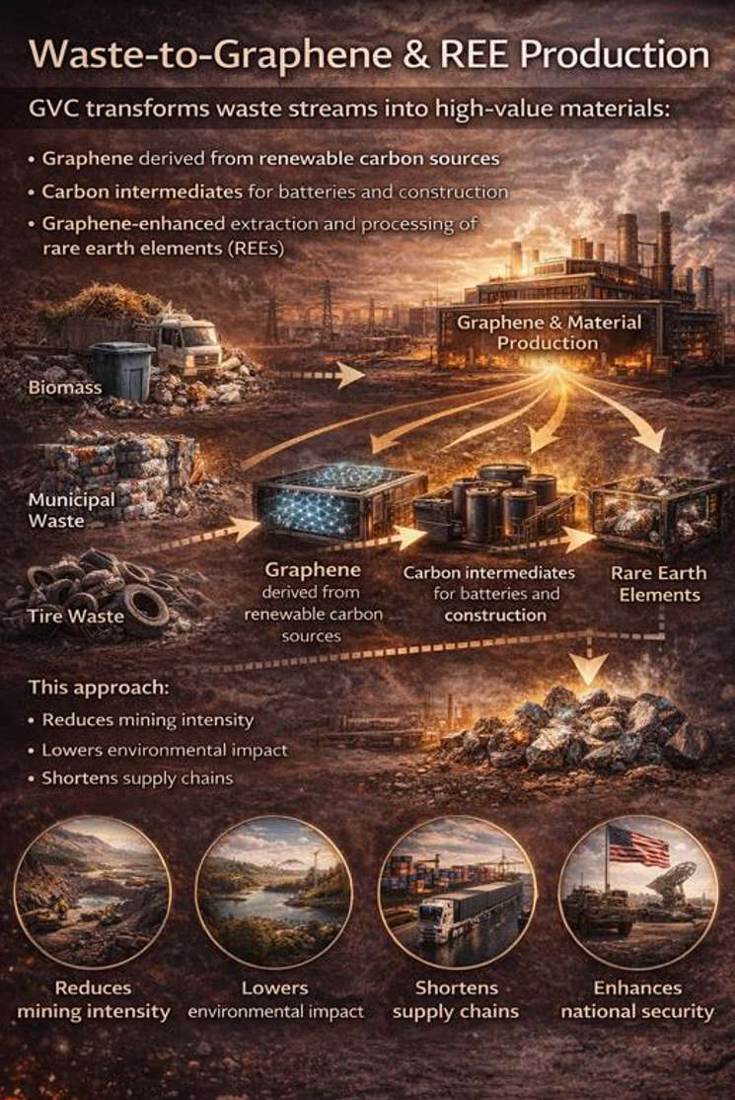
Builds and operates distributed generation, waste-to-energy, biomass-to-hydrogen, renewable fuels, microgrids, industrial heat, energy storage, and efficiency systems for data centers, industrial campuses, agricultural hubs, clinics, and GVC LIFE centers. Four principles: waste is feedstock, energy should be local, efficiency is production, and energy and carbon are one system.
What graphene does for it
Battery and capacitor materials raise storage density and safety. Thermal materials make power electronics and motors run cooler. Catalytic graphene supports hydrogen production. And the carbon side of every energy process becomes feedstock for graphene and soil products instead of waste.
What it gives back
Products and capabilities
- Motor and industrial efficiency systems CommercialRetrofit systems that cut electricity use in motors, pumps, fans, compressors, and HVAC, sold on measured savings. A kilowatt saved is a kilowatt produced, and this line produces cash flow from day one.
- Waste-to-energy and biomass-to-hydrogenPlants that convert agricultural residue, forestry waste, municipal waste, and industrial byproducts into electricity, hydrogen, renewable fuel, and carbon products.
- Microgrids and distributed generationLocal, resilient power for sites where the grid is weak, slow, or absent: data centers, rural clinics, agricultural processing, defense outposts, GVC LIFE centers.
- Energy storage systemsStorage built on graphene-enhanced battery and capacitor materials for grid, industrial, and mobility applications.
- Data-center power integrationEnergy designed together with cooling, materials, and construction so compute is not stranded waiting on interconnection.
Compute
Intelligence is now infrastructure. GVC builds the whole stack, from the processor to the building.
What it does
Compute is physical. It depends on chips, boards, interconnects, cooling, power, buildings, water, and supply chains, and it is running into hard limits on every one of them. GVC attacks the problem at every level: processor, board, thermal path, energy supply, facility, and data layer.
What graphene does for it
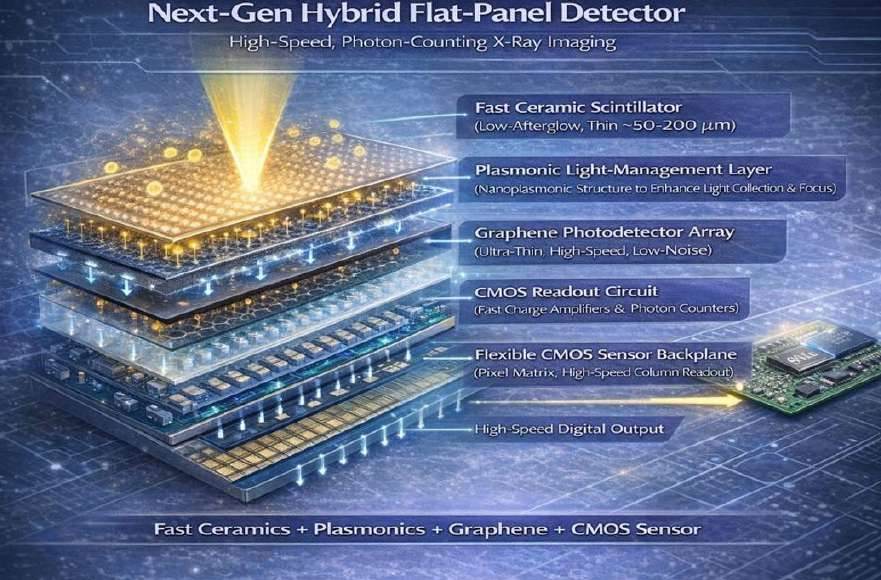
Graphene-enabled boards and interconnects move signals faster with less heat. Graphene thermal materials move that heat out. Graphene-enhanced components extend hardware life and raise rack density. The material advantage shows up as more compute per watt and per square foot.
What it gives back
Products and capabilities
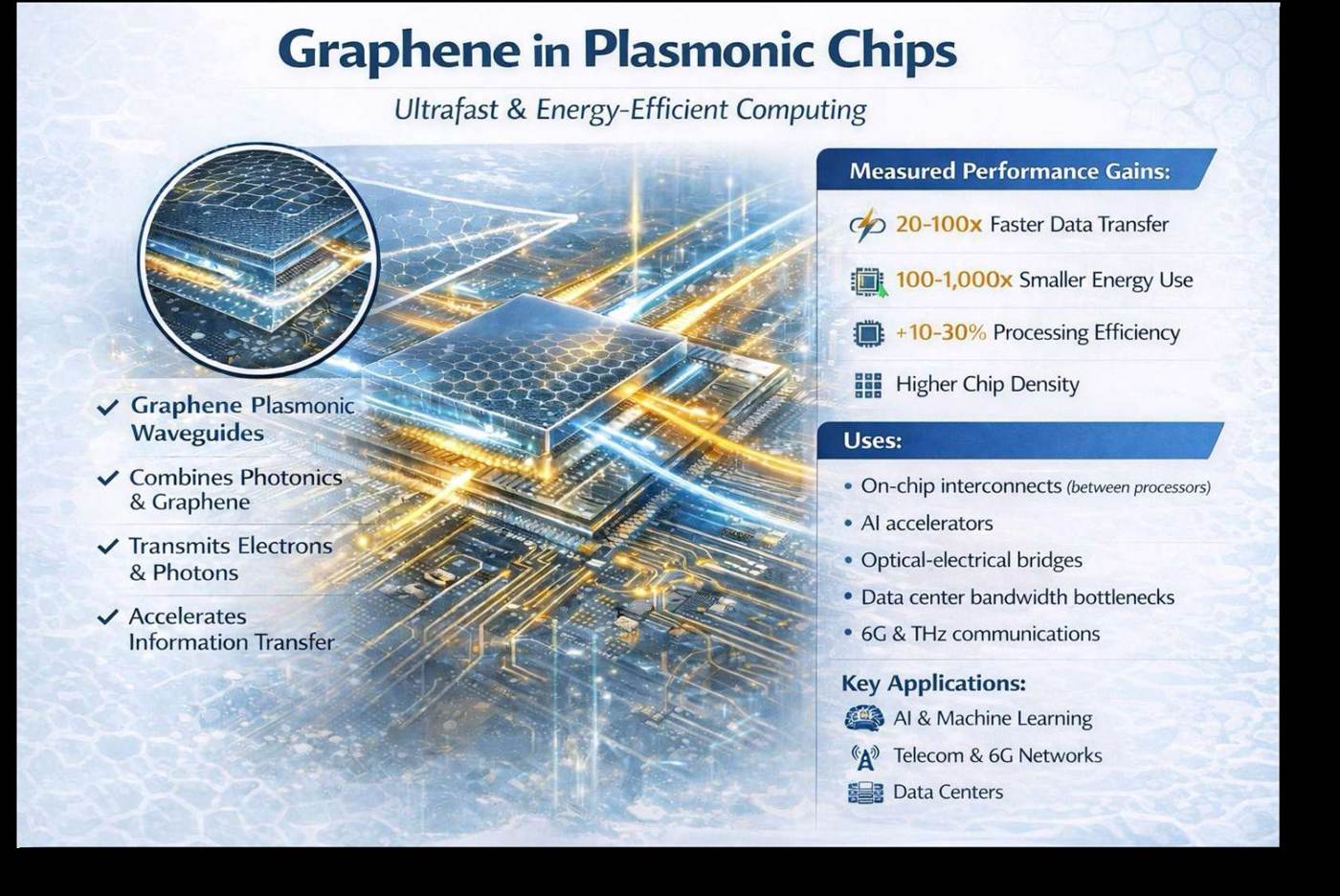
- Plasmonic processing architecture In developmentA processor design that uses light-speed behavior and coherent electron waves rather than conventional electronics to move information, aimed at the speed and heat limits of current chips.
- Graphene-enabled circuit boards and interconnectsBoards, cabling, and conductive pathways with better signal integrity, heat transfer, and durability than copper-only designs.
- AI acceleration hardwareAccelerator systems built with graphene thermal and interconnect components, for training and inference workloads.
- Sovereign and secure computeData-center capacity operated inside GVC's trusted data architecture for customers who cannot run sensitive workloads on foreign-controlled or shared infrastructure.
- Edge computeRight-sized, secure systems for clinics, industrial sites, and GVC LIFE centers where latency and connectivity make centralized compute the wrong answer.
- Data centers as integrated systemsFacilities designed with GVC energy, cooling, materials, and construction so the building performs as one machine.
Data, AI & Trusted Infrastructure
Data is the layer under every other pillar. GVC captures it, protects it, governs it, and uses it.
What it does
Most organizations do not control their data. It is scattered across systems, governed inconsistently, and handled by third parties whose incentives are not the owner's. This pillar builds the unified data infrastructure that runs under GVC's own operations and is offered as a platform to healthcare providers, research institutions, enterprises, and governments. Five functions: protection, governance, AI, integration, and monetization.
What it gives back
Products and capabilities
- Trusted data platformA layered architecture separating high-performance storage from a distributed verification layer, with identity, consent, and permissioning enforced at every access. Full description on the security page.
- Provenance and auditA tamper-evident record of when data was created, accessed, changed, or shared, verifiable without trusting a single operator.
- Healthcare data environmentImaging, diagnostics, and records unified under patient consent and made available to AI and clinical workflow under rules.
- Scientific and IP data environmentExperimental results, simulation outputs, and design pathways from the Innovations Lab held as protected assets.
- Governed AI training and inferenceModels that access only permissioned data and whose outputs trace back to the data they were built on.
- Legal, enterprise, and government data productsChain-of-custody evidence management, trade-secret collaboration environments, and sovereign data hosting.
Health & Wellness
Find disease earlier, treat it with less damage, and know the patient well enough to prevent the next one.
What it does
Most healthcare is built around late intervention. GVC's pillar is a healthcare stack that runs the other direction: access first, then diagnosis, then treatment, then a record that learns. Three sub-pillars: medical devices, pharmaceutical and therapeutic products, and healthcare delivery. What separates it from a device company is that GVC controls deployment. It owns the channel to the patient, the reading of the result, the record, and the data.
What graphene does for it
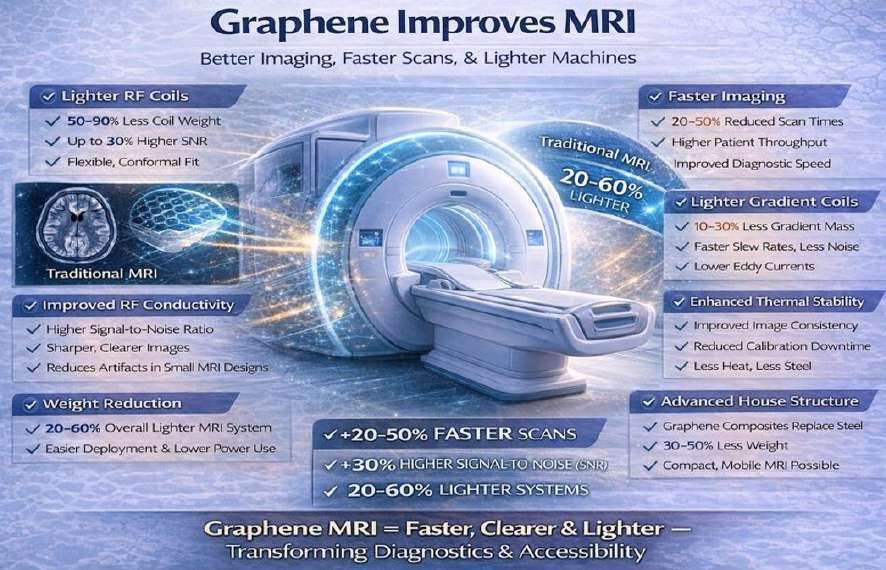
Thermal materials in imaging and treatment equipment. Sensor surfaces built on functionalized graphene. Structural and coating materials for devices and facilities. Quantum dots for imaging and diagnostics as those routes mature.
What it gives back
Products and capabilities
- Mobile and fixed care deliveryA delivery platform that brings diagnostics, screening, and treatment to patients in clinics, mobile units, employer programs, rural regions, and GVC LIFE centers instead of waiting for patients to find them.
- Radiology reading and diagnostic workflowControl of the interpretation layer, so every scan is read, reported, and integrated into a care plan with structured data captured.
- Advanced imaging line Cleared, in marketHigh-definition CT, fluoroscopy, digital radiography, intraoperative and interventional imaging, mobile imaging, and mobile nuclear molecular imaging, designed for settings conventional systems cannot serve.
- Ten-minute cardiovascular screening Cleared, in marketNon-invasive, body-wide electrical signal analysis that assesses the functional state of the whole cardiovascular system in about ten minutes. Fast, repeatable, and suited to population screening. The foundation of the Human Heart Health initiative: screen everyone, repeatedly, and take heart disease off the list of leading causes of death.
- Pulsed metabolic therapy In marketPhysiologic delivery of insulin in pulses that mimic the healthy pancreas, aimed at restoring metabolic function and reducing the complications of diabetes.
- Regenerative therapy for pain, inflammation, and tissue repairA frequency and waveform platform designed to reduce pain and inflammation while promoting regeneration and remodeling of tissue, with applications in orthopedics, spine, sports medicine, wound care, and chronic disease.
- On-demand ozonated water for sanitation and wound careHigh-saturation ozonated water produced at the point of use for hospitals, clinics, homes, restaurants, and food safety.
- Mental and neurobehavioral health technologyTreatment technology for depression, PTSD, and autism-related applications, deployed through controlled care channels with structured outcomes tracking.
- Patient record and intelligence layerAn EMR built to hold genetics, epigenetics, life and family history, imaging, cardiovascular, metabolic, mental health, treatment, and outcomes data in one governed place.
- AI for prediction and preventionModels built by GVC data scientists on GVC's own governed data, aimed at identifying disease patterns before they become diagnoses.
Agriculture & Water
Soil, water, food, and biomass are life systems. GVC treats them as strategic infrastructure.
What it does
Restores soil, cleans and secures water, produces biomass, creates local food security, and builds resilient regional economies. It is also the front end of the closed loop: agricultural waste becomes energy, hydrogen, graphene, and soil products.
What graphene does for it
The center of the pillar is a graphene-based soil product made to strict tolerances. Ordinary biochar varies with feedstock, temperature, and process, which is why it works in one field and disappoints in another. A product made to a specification performs consistently across soil types, and consistency is what farmers and food-security programs can build on. Graphene membranes and media do the same job for water.
What it gives back
Products and capabilities
- Graphene soil biostimulantA soil amendment engineered for nutrient retention, water retention, microbial activity, and soil structure, produced to tight tolerances for repeatable performance. Not a fertilizer replacement; a platform that makes the whole soil system work better.
- Water filtration and purification systemsGraphene-membrane systems for contaminant removal and purification for households, clinics, farms, industry, and communities.
- Desalination and wastewater reuseModular systems for regions where fresh water is the binding constraint.
- Modular water infrastructure and monitoringDeployable water systems with embedded sensing for GVC LIFE centers, agricultural hubs, and sovereign programs.
- Biomass offtake and processingCollection and conversion of agricultural residue, food waste, and forestry waste into feedstock for Energy and Graphene.
Construction Materials
The world cannot build the next economy with yesterday's materials.
What it does
Turns graphene, advanced carbon, coatings, sensors, and composites into the physical ingredients of buildings and infrastructure: concrete, asphalt, glass, panels, insulation, and structural components. GVC is its own first customer, using these materials in its own data centers, clinics, and industrial campuses, which produces the performance evidence that lowers the risk of every outside sale.
What graphene does for it
Concrete is one of the most used materials on Earth and one of the largest sources of carbon emissions. Graphene admixtures raise strength, durability, water resistance, and crack resistance, and allow less cement per unit of performance. The same logic applies to asphalt, glass, and coatings. Embedded graphene sensing makes the material report on itself.
What it gives back
Products and capabilities
- Graphene concrete admixturesAdditives that improve strength, durability, water and crack resistance, thermal performance, and lifespan while allowing cement reduction.
- Graphene asphalt and road surfacesSurface materials with longer life and lower lifecycle maintenance, and a path to roads that sense their own condition.
- Smart glass and building skinsWindows, façades, and surfaces that manage heat and light and reduce building energy use.
- Panels, composites, and modular systemsRepeatable, durable construction materials for fast deployment of clinics, housing, schools, data centers, and GVC LIFE centers.
- Coatings and protective surfacesCorrosion-resistant, water-resistant, and thermal coatings for structures and infrastructure.
- Self-sensing structural materialsMaterials with embedded sensing that report stress, heat, moisture, and failure risk into the data layer.
Construction & Development
GVC builds the places where its technologies run.
What it does
Designs, develops, and constructs data centers, energy sites, water systems, healthcare facilities, industrial campuses, housing, and GVC LIFE centers, using GVC materials, GVC energy, and GVC data systems from the first drawing. The built asset is a product, a customer, and a proof at the same time.
What graphene does for it
Every structure is built with graphene-enhanced concrete, coatings, thermal systems, and embedded sensing. The building performs better, costs less to operate, lasts longer, and reports on its own condition.
What it gives back
Products and capabilities
- Integrated data-center developmentCampuses designed as one system: power, cooling, materials, structure, security, and network, built faster and operated cheaper than conventional facilities.
- Healthcare facility developmentClinics and diagnostic centers, fixed and modular, built to deploy the Health pillar's equipment and workflows.
- Energy and water site constructionWaste-to-energy plants, microgrid sites, water treatment and desalination facilities.
- Modular and rapid-deployment constructionRepeatable building systems for GVC LIFE centers, housing, schools, and sovereign infrastructure programs.
- Industrial and manufacturing campusesFacilities for GVC's own materials and electronics manufacturing and for partners.
Mobility
Transportation is being rebuilt around the constraints GVC is built to solve: weight, heat, energy, and data.
What it does
Planes, trains, automobiles, drones, autonomous systems, commercial fleets, logistics networks, and charging infrastructure. Mobility is where materials, energy, compute, and data come together in motion, and where every pillar's products get moved, delivered, and serviced.
What graphene does for it
Mobility is a constant fight against weight, heat, wear, corrosion, and power loss. Graphene composites cut weight. Graphene coatings resist wear and corrosion. Graphene thermal materials keep batteries, motors, and electronics cool. Graphene battery materials extend range and shorten charge time.
What it gives back
Products and capabilities
- Lightweight structural components and coatingsGraphene composites and coatings for vehicles, aircraft, rail, and drones.
- Battery, capacitor, and thermal systems for vehiclesStorage and cooling built on GVC materials for longer range, faster charging, and safer packs.
- Charging and energy orchestrationCharging infrastructure tied to GVC distributed generation and storage so fleets are never waiting on a weak grid.
- Drone and autonomous platformsLightweight, long-endurance platforms for delivery, agricultural monitoring, medical supply, mapping, and security.
- Fleet telemetry and optimizationPredictive maintenance, routing, charging management, and safety built on the trusted data layer.
- Mobile healthcare and service platformsVehicle platforms that carry imaging, screening, and treatment to the patient.
Defense & Security
Security is now inseparable from energy, materials, compute, data, health, water, and supply chains.
What it does
Modern national security is about resilience: whether a country can power itself, feed itself, protect its data, move its people, build its infrastructure, secure its materials, and care for its wounded. The same technologies that strengthen GVC's commercial ecosystem strengthen that resilience. This pillar packages them for defense and security customers.
What graphene does for it
Lighter structures, stronger armor and composites, ruggedized electronics that run cooler, better optics and detectors, hardened facilities, and supply-chain independence for critical materials.
What it gives back
Capabilities
- Secure and sovereign compute and dataMission-ready compute inside the trusted data architecture, with provenance, permissioned access, and auditability for sensitive workloads.
- Advanced materials for defense systemsLightweight composites, ruggedized thermal management, protective coatings, and structural materials.
- Energy independence for installationsMicrogrids, storage, waste-to-energy, and hydrogen for bases, outposts, and disaster response.
- Mobile healthcare and ruggedized diagnosticsImaging, cardiovascular screening, regenerative therapy, and wound care that deploy to austere settings.
- Water purification and sanitationPoint-of-use purification and ozonated-water sanitation for field and installation use.
- Critical minerals and rare earth recoveryDomestic separation and recycling that reduces dependence on concentrated foreign supply.
- Drones, autonomous systems, and rugged mobilityPlatforms built on GVC materials and energy systems.
Finance
Finance is not a back office. It is the bloodstream of the stack.
What it does
A company that builds data centers, energy plants, clinics, water systems, and manufacturing cannot run on one kind of capital. Finance is an operating capability at GVC: it matches the right capital structure to the right asset, funds acquisitions of blocked technologies, structures project finance for infrastructure, and makes pay-per-use and leasing models possible so a good technology never stalls for lack of a payment structure.
What it gives back
Capabilities
- Capital formation at every levelParent, pillar, project, and asset-level capital, each structured for the asset it funds.
- Acquisition financeDeal structure, valuation, milestone funding, earnouts, and secured lending for technologies the market has not yet understood.
- Project and infrastructure financeLong-life assets with contracted revenue financed off the parent balance sheet.
- Equipment leasing and pay-per-useStructures that let clinics, farms, and industrial customers adopt GVC products without capital outlay.
- Carbon and performance valueCapture of carbon credits and performance-contract value across Energy, Agriculture, and Construction.
- Data-native financial infrastructureFinancial data flows embedded in the trusted data layer, with room for tokenized and hybrid models as they mature.
The Innovations Lab
The lab is the center of GVC. Every pillar runs on science and engineering that the lab produces, tests, and improves. It is built as a modern analogue to Bell Labs, Xerox PARC, and Lawrence Livermore, and it is built on a discipline those institutions never had a name for.

Why a lab at the center
Most companies buy technology, or license it, or hire around it. GVC develops it. A technology that enters GVC as a good product leaves the lab as a better one: a motor system made more efficient, a medical device made more durable, a data-center component that runs cooler, a building material made stronger, a battery made denser, a coating that lasts longer, a filtration system that performs better, a vehicle made lighter. The lab tests, graphenizes, reformulates, validates, and integrates. It does research, but its output is not papers. Its output is products that work, and a record of exactly why they work.
That record is the asset. Bell Labs produced the transistor, the laser, and information theory because it kept the best scientists in the world in one building with the freedom to work on hard problems and the obligation to make them real. GVC does the same thing without the building, and with one addition the twentieth century did not have: AI, used correctly.
Actual intelligence
Three words get confused with one another, and the confusion is expensive. AI is a technology. Actual intelligence is an arrangement: a person or a team working with that technology in a way that amplifies human judgment instead of substituting for it. Epistemic intelligence is a standard: the discipline that determines whether what the arrangement produces corresponds to the world.
Remove the standard and keep the arrangement, and you get amplified error: a capable person moving very fast, producing confident work, properly formatted, apparently sourced, and wrong. That failure does not look like a failure from the inside. It is the most likely way for an organization to lose a decade, and the lab is designed so it cannot happen here.
Intelligence that acts on the world instead of describing it. That is what actual means, and it is what the lab is for.
The four properties
Epistemic intelligence is the standard a body of knowledge is held to: what is known, at what confidence, from what source, with what failed still on the record. It is not raw intelligence, not information, not expertise, and not skepticism. It can be built into a person, an institution, or software out of four properties that can be specified and audited.
- Provenance. Every claim carries where it came from, attached to the claim rather than stored beside it. A number from a supplier datasheet enters the record as a vendor claim with a revision and a date, never as a measurement.
- Calibrated confidence. How much a claim is trusted is recorded as data, not implied by tone, and it propagates. A conclusion that needs four things to be true cannot be more confident than the weakest of them.
- Retained failure. Nothing is overwritten. Experiments that failed, runs that were abandoned, hypotheses that were set aside, all stay in the record with the reason. The value of a negative result is realized years later by someone not yet in the building.
- Independent validation. No system certifies its own conclusions. The layer that produces a result is never the layer that tests it.
Outside the four sits the check that cannot be argued with: the device performs or it does not. A process holds yield or it does not. The world cannot be persuaded, and its verdict arrives whether anyone wanted it. An organization that builds has access to that referee. One that only publishes does not. That difference is worth more than any amount of internal process, and it is the reason the lab sits inside an operating company rather than beside one.
How the lab is built
The four properties are a specification. Assembled into something that runs, they become five layers, and the separation between the layers is the design.
| Layer | What people do | What AI does | What settles it |
|---|---|---|---|
| Substrate One store of everything the organization has learned, with no privileged place for successes. | Run the experiments. Record what happened, including the failures. Decide what is worth attempting. | Index and retrieve. Extract structured records from documents and instrument output. Surface prior attempts nobody remembered. | Retrieval over the internal corpus. Extraction models. |
| Claim Everything the organization believes, each belief carrying what it rests on, how confident it is, and what would change it. | Judge what a result means. Set the confidence. Decide which gaps matter for the decision at hand. | Draft the synthesis, trace each assertion to its source, flag where a stated confidence exceeds what the source supports. | Language models constrained to cite from the substrate. Statistical tooling. |
| Generation Where new designs come from. | Define the objective, the constraints, and what counts as success. Choose among candidates. | Propose candidates at volume. Search the design space against constraints. Predict properties before anything is built. | Generative design, physics and chemistry simulators, property-prediction models trained on internal data. |
| Review The adversarial layer. | Hold the authority to reject. Weigh disagreement between reviewers. Decide what gets built. | Look for the reason a conclusion fails, from independent architectures, and report when no reason is found. | Separate model families from separate vendors, run against held-out data and pre-registered predictions. |
| Reality The last check, and the one that is not epistemic. | Build it. Measure it. Record the outcome against the prediction, whichever way it went. | Nothing. | Test equipment, pilot lines, prototypes, field deployment across GVC's own infrastructure. |
The general rule holds in every layer. People set the objective, define the constraints, judge what a result means, and carry the authority to stop. AI searches, retrieves, synthesizes, generates candidates, simulates, and reviews. Instruments and the physical world settle the question. The review layer has the authority to reject work and a budget that does not move with the success of what it evaluates; without both, review becomes a formality and everyone inside knows it.
What the lab's AI platform does
- Mines data for science and retains it permanently: the literature, the patent record, and above all GVC's own experimental and field results, positive and negative.
- Helps design and engineer products, searching the design space and predicting properties before anything is built.
- Scans patents, finds design-arounds, and produces a freedom-to-operate analysis for each product, run under legal privilege.
- Tests engineered designs for efficiency, cost, effectiveness, buildability, and graphene improvement before a prototype is committed.
The three judgments
The machinery makes a decision possible. The judgment is what makes it intelligence, and three judgments do most of the work. None of them can be automated, because each depends on the consequence being weighed.
- How much weight a filtered finding can carry. The published record is biased toward positive results by an amount nobody has measured. The skill is knowing how much to discount, and in which direction.
- Which gaps are decisive. Every record has holes, and most do not matter. The useful question is narrow: if this unknown resolved the worst plausible way, would the decision change.
- When to act on an incomplete record. Waiting is a decision with a cost paid by whoever needed the result during the wait. Where a wrong action can be detected early and undone, acting on thin evidence is often right. Where it cannot, the burden inverts.
The Six I's
- Identify the problem, the constraint, and the blocked technology.
- Imagine what graphene and adjacent science could change about it.
- Invent the material, the design, or the process.
- Incubate it in GVC's own infrastructure, where it generates real data.
- Innovate the product and the business model around it.
- Impact the market and the people the product serves.
Proprietary by design
The lab's results are held as assets of the organization. They are not published. The traditional publication system rewards volume and novelty and discards failure; it does not reward the compounding of a private, complete body of knowledge that lets one organization build faster and cheaper than anyone else. That compounding is the lab's purpose. An organization that writes down what the world said, including every time the world said no, gets faster every year. One that publishes its successes and forgets its failures starts over every project.
A virtual lab
Scientists, engineers, and researchers across regions and disciplines work separately and form teams as problems require, alongside AI, reviewing one another's work and cross-pollinating ideas. They are incentivized by the results of the research and engineering rather than by publication. Culture is treated as a component of the structure, because a lab in which the review layer is a formality, or in which a failed experiment is an embarrassment rather than an entry, will not produce what this one is built to produce.
What the lab serves
Every pillar sends the lab problems and receives products. Every deployed product sends the lab data. That loop, run under the four properties, is the engine of the company.
Trusted data and security
GVC's data layer is built on a simple rule: separate trust from performance, and enforce governance at every access. Here is what that means in practice, and what is built, designed, and planned.
The problem
Most organizations do not truly control their data. It is stored across disconnected systems, accessed through inconsistent permissions, and managed by third-party platforms whose incentives are not aligned with the owner's. Security is uneven. Provenance is unclear. Value is captured by intermediaries. Healthcare, scientific research, legal evidence, and financial systems all suffer from the same structural gap.

The architecture
No single technology can satisfy high-performance storage, distributed trust, identity, AI workflow, and economic participation at once. Forcing them into one layer produces a slow, brittle system. GVC uses a layered model in which each layer does one job and the interactions between layers are explicit and controlled.
- Data center and infrastructure. GVC's own facilities and distributed edge nodes provide compute, storage, and secure connectivity, designed together with energy and cooling for high-density workloads. Data is processed close to its source where latency or connectivity require it, and synchronized with the global system.
- Data fabric. The primary repository, built from systems suited to each data type: distributed relational databases for structured records, document stores for unstructured content, object storage for imaging and large binaries, streaming systems for real-time industrial data. Presented to higher layers as one governed resource.
- Trust and verification. A decentralized layer that records cryptographic representations of data states and logs every significant interaction, distributed across nodes so unauthorized change is hard to make and easy to detect. This layer does not store the data. It anchors the existence and history of the data, which preserves performance while making every interaction auditable and establishing chain of custody.
- Identity, permission, and consent. Determines who can access what, under which conditions. Identity for people, organizations, and automated processes. Permissions by role, attribute, context, and purpose. In healthcare, patients grant, revoke, and modify access; institutions enforce regulation; emergency access exists and is fully audited. Every access event is recorded in the trust layer, so governance is not only enforced but demonstrable.
- Monetization and economics. Data owners define the terms under which data may be used. Access is priced, transactions execute automatically, and revenue is shared among participants. Traditional and tokenized models are both supported.
- AI and analytics. Training pipelines see only permissioned data. Inference outputs are captured back into the fabric and are traceable to the data they came from. AI is a native capability of the platform, operating inside the rules.
- Applications. Domain-specific tools for healthcare, research, enterprise, legal, and government, all running on the same infrastructure so vertical solutions never duplicate core functionality.
What this delivers
- Verifiable integrity: proof that a record has not been altered.
- Immutable audit: a complete history of who touched what, when, and why.
- Reduced single points of control: trust does not depend on one operator.
- Chain of custody across institutions and jurisdictions.
- Sovereign hosting inside GVC-operated data centers for customers who cannot use shared or foreign infrastructure.
- Cryptographic standards selected against current guidance, including post-quantum algorithms where they are standardized, reviewed on a schedule as standards change.
Built, designed, planned
Built
- Decentralized database and trust layer with existing government deployments
- Core identity and permission framework
- Healthcare data flows for imaging and diagnostics
Designed
- Full layered platform architecture
- Consent model for patient data
- Scientific and IP data environment for the Innovations Lab
- Data-center integration and edge nodes
Planned
- Monetization and revenue-sharing layer
- Tokenized and hybrid economic models
- Legal and enterprise chain-of-custody products
- Sovereign data offerings for governments
Execution
GVC does not rebuild what exists. It uses proven technologies for storage, databases, and infrastructure and focuses its own development on the layers that differentiate: trust, permissioning, monetization, AI integration, and the vertical applications. That keeps capital requirements down, shortens time to market, and lets components be replaced as better ones appear without disturbing the system.
GVC LIFE
The whole PillarStack, deployed as a self-sustaining economic center in a region that has land, sun, water, and biomass but not the infrastructure to turn them into prosperity. GVC LIFE is the program formerly called the Micro-Industrialization Infrastructure Initiative.
Why
Much of the world lives near everything needed for a productive economy and lacks the systems to use it. Power, water, food, health, manufacturing, construction, and education arrive as separate projects run by separate organizations, if they arrive at all. A GVC LIFE center delivers them as one integrated system, sized to the region, and operated to generate local jobs, local production, and local data.
The order of operations
- Energy. Power first. Waste-to-energy, microgrid, storage.
- Water. Purification, desalination where needed, monitoring.
- Agriculture. Soil restoration, local food production, biomass collection.
- Healthcare. Mobile and fixed diagnostics, screening, treatment, sanitation.
- Manufacturing. Local production of materials and goods from local feedstock.
- Construction. Housing, clinics, schools, and facilities from modular GVC materials.
- Education. Training people to operate and maintain all of it.
What LIFE means
Food, water, energy, housing, medical care, and secure data are the six things a community needs to stand on its own. A GVC LIFE center provides all six from local resources, run by local people, and it does so without polluting the region it serves. The waste that would have been burned becomes power. The carbon that would have gone into the air goes into soil and into materials. The energy that would have been lost in inefficient motors and buildings stays in the community. That is the humanitarian mission of GVC made physical.
What makes it work
Each layer supplies the next. Agricultural waste powers the energy plant. The energy plant runs the water system and the clinic. The clinic generates health data. Local manufacturing turns biomass into materials. Compute is right-sized and local, so the community can understand and maintain it, while remaining integrated with the global platform so local operations are informed by global intelligence. Finance structures it as infrastructure with long-term revenue, not as aid.
GVC LIFE is not charity. A region that can produce its own food, clean its own water, and power itself becomes more stable, less dependent, and more valuable. It also becomes a customer for everything else GVC makes.
For investors
The public pages describe the model, the technology, and the pillars. Materials with financial detail are made available to qualified parties under a confidentiality agreement.
Where to start
- The PillarStack model: how the company is structured and why the pillars compound.
- How graphene becomes value: the value ladder from raw material to recurring revenue and data.
- What is proven, what is not: how we separate engineering from physics claims.
- Trusted data and security: the layer under everything, and what is built versus planned.
Request access
Qualified investors and institutions can request access to the confidential data room. Nothing on this site is an offer to sell or a solicitation of an offer to buy any security. Contact information for the investor relations office will be posted here.
For partners
Suppliers, customers, governments, research institutions, and technology owners. Start with the pillar closest to your world.
Technology owners
GVC looks for technologies that are real, blocked, and improvable: real because they work, blocked because they have not reached the market for reasons of capital, channel, or completion, and improvable because graphene or the rest of the stack can make them better. If that describes what you have built, GVC wants to talk. The Innovations Lab is where those conversations begin.
Governments and sovereign programs
Energy, water, food, health, compute, and data security delivered as an integrated system rather than a set of disconnected projects. See GVC LIFE and Defense and Security.
Join GVC
GVC is building a founding team across materials science, chemistry, electrical and mechanical engineering, software, data science, clinical operations, manufacturing, construction, and finance.
What working here means
You will work on problems with physical consequences, in an organization that treats scientists and engineers as the people who make things real rather than the people who write about them. You will use AI every day, and you will remain responsible for the judgment. Your results will be held as assets of the company and will compound into the next product rather than disappearing into a journal.
The lab is virtual. Teams form around problems across regions and disciplines. Incentives follow results.
Where to start
Open roles and application details will be posted here.